Home » Electrotherapy; Electrodiagnosis
Electromyography (EMG)


EMG is a technique for evaluating and recording the electrical activity produced by skeletal muscles. EMG is performed by using an instrument called electromyography, to produce a record called electromyogram.
EMG involves detecting, amplifying/ analyzing, imaging/ auditory sound/ audiovisual sounds. These processes occur when the muscle contract. It provides a powerful tool for documenting the role of muscle in physical activity and for assessing neuromuscular system (nerve + muscle + motor unit + neuromuscular junction).

History:

EMG was first accomplished by Helmholtz in 1850 but its clinical efficacy was not recognized until animal experiment showed its method and observations. In 1926 Adrian and Brank introduce the concentric needle for a single motor unit and a single muscle fiber.
The development of CRO (Cathode Ray Oscilloscope) and electronic regarding machine made it possible as one of the vital role and clinical significance in the electrodiagnosis.

Motor unit:

  • AHCs
  • Axons
  • Neuromuscular junction
  • Muscle fibers

Action potential:

The stimulus which causes depolarization is called Action potential. The influx of Na ions is called depolarization. The action potential of motor unit is called motor unit action potential.

Recording of EMG:

Recording is done by the following three phase system.
  • Input
  • Amplifier
  • Display/ Audiovisual} Output

  I.    Input:

Electrodes

As it is known that when all the normal muscles contract, the muscle fiber in the motor unit depolarize and repolarize at the same time and a local disturbance is produce in the muscle. This disturbance can be detected either by the surface electrodes or needle electrodes (recording electrodes). There are two methods by which we can detect this disturbance by monopolar technique or bipolar technique. The number of electrodes are used for any study are three in number.
  1. Recording electrodes
  2. Reference electrode
  3. Ground electrode
            The ground electrode provides a mechanism for cancelling out the interference affect of external noise.
Monopolar technique:
In monopolar technique, the recording electrode should be placed over the muscle belly or inserted in the muscle fibers. The second electrode (reference electrode) is placed over the area where the muscle is inserted. The reference electrode should be surface electrode. The ground electrode should be placed near recording electrode.
Bipolar technique:
In bipolar technique, the two surface electrodes (recording as well as reference) are placed over the muscle belly in the longitudinal direction parallel to the muscle fibers and when the needle electrodes are used two wires are inserted through the cannula in the muscle belly. In this method ground electrode is not needed.

                   II.    Amplifier:

The electrical activity derived from the body is very small i.e. mv or μv and contain undesired signals. The amplifier is conditioned to amplify that undesired signals and the useful signals derived from the motor units.

                  III.    Display system:

After the signal is processed and amplified, it is displayed on the CRO which permits visual display of the motor unit. The CRO does not provide a permanent record, it only allows the signal to be displayed for a few seconds. However, if a photographic system is attached to the CRO a permanent record can be obtained. A CRO consists of the electric gun, screen, horizontal and vertical plates. The electron gun projects the electric beam towards the screen through the two sets of plates. As the electron beam passes, there is deflection at the vertical plates and sweep at the horizontal plate. The deflection at the vertical plate is shown as vertical plate signal voltage in micro volts and the sweep at the horizontal plate shows the duration of signals in milliseconds. A tape recorder may be used to store the EMG information so that it can be redisplayed.

Normal EMG results:

Muscles at rest are inactive. During the insertion of the needle electrodes some spontaneous activities will be heard. When the needle comes to rest there will be no spontaneous activity at normal circumstances. When the muscle is voluntarily contracted action potential begins to appear. As the strength of contraction is increased more and more muscle fibers produce action potentials. These action potentials appear on screen of EMG.

Abnormal EMG results:

                 IV.    Spontaneous activity:

As a normal muscle at rest shows electrical silence, any activity during the relaxed state is known as spontaneous activity. These spontaneous activities are not produced by the voluntarily muscle contraction. Four types of spontaneous action potentials have been identified.

                   V.    Fibrillation potential:

These spontaneous potentials are arises from spontaneous depolarization of a single muscle fiber. They may have up to three phases with amplitude between 20 -300 μv and duration is 2 ms. They produce high pitch click sound having frequency 30 pulses/ s. they are indicative of lower motor neuron disorders such as peripheral nerve lesion (peripheral neuropathy), AHC diseases, rediculopathy, polyneuropathy but found in lesser extent in myopathic diseases such as muscular dystrophy, poliomyositis and myasthenia gravis.

                 VI.    Fasciculation potential:

There are spontaneous potentials seen with irritation and degeneration of AHCs, compression of the nerve roots as well as muscle spasm or muscle cramps (muscle fibers overlap each other) or muscle guarding. They are found in Mylopathies, Myopathies, benign myokemia, motor poliomyelitis, spinal muscular dystrophy. These fasciculating potential may be 5 -200 μv, duration is 5 – 25 ms, frequency is 50 pulses per second they produce low pitch thump sound.

                VII.    Positive sharp waves:

There are descriptive because they produce initial positive deflection. Usually they are monophasic but can be diphasic. The negative phase is off much lower amplitude and longer duration (sometimes up to 100 ms) than positive phase. The peak to peak amplitude is variable but may be up to 1 mv. Their duration may vary greatly 2 – 100 ms. But usually the duration is in between 10 – 20 ms. Frequency is 10 pulses/ second. They produce characteristic dull sounds. They are found in denervated muscle along with fibrillation potential. Primary muscular disorders such as muscular dystrophy, polymyositis, positive sharp waves and fibrillation potential are rarely found in UMN lesions.

Strength duration curve (SDC)


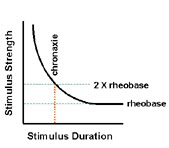
It shows the interdependence between stimulus strength and the time required in activating the muscles. It indicates the strength of impulses of various durations required to produce muscle contraction by joining the points that graphically represent the threshold value along the ordinate for various durations.

Advantages of SDC:

  • This is a simple, reliable and shows a proportion of denervation.

Disadvantages of SDC:

  • In large muscles it can not shows the full pictures but only a proportion of muscle fibers can be stimulated.
  • It can not show the site of lesion.

Optimum timing of SDC:

SDC test can be done 10 – 14 days after the lesion has occurred. The degeneration of nerve from the proximal to distal is called Wallerian degeneration. When the motor end plate is no longer functioning, it is done weekly under the same condition until there is recovery and decision has been reached on the eventual final state of the muscle. SDC is used to identify denervation, partial innervation, and compression.

Methods of SDC:

Take a neuromuscular stimulator (TENS, DL­ stimulator) having rectangular duration i.e. 0.3, 0.1, 1, 3, 10, 30, 100, 300 ms and constant current. Put the passive electrode over the midline of the body or near the origin of the muscle. Put the active electrode over the fleshy belly of the muscle.
Alternately both the electrodes are placed on both ends of the muscle. First apply current having longest duration and look for minimum perceptible contraction, gradually shorten the impulse duration and note the corresponding increase in current strength. The electrode placement should not be changed through out the test. Plot a SD graph from the results of the test.

Characteristics of SDC:

     i.        Innervated muscles:

When all the nerve fibers supplying the muscles are intact, the strength duration curve has a shape characteristic of normally innervated muscles as shown in the figure.
The same strength of stimulus is required to produce a response with all the impulses of longer duration, while those of shorter duration require an increase in strengths of the stimulus each time the duration is reduced.

   ii.        Denervated muscles:

When all the nerve fibers supplying a muscle have degenerated, the strength duration produced is characteristic of complete denervation as shown in the figure.
For all impulses with duration of 100 ms or less the strength of the stimulus must be increased each time the duration is reduced and no response is obtained to impulses of very short duration. The curve rises steeply and is shifted to the right than that of normally innervated muscle.

  iii.        Partial denervated muscles:

For the stimulation of denervated fibers impulses of longer duration are required while for the stimulation of innervated fibers impulses of shorter duration are required. The kink produce show the partial denervation which disappear after 10 -20 days or month.

·        Rheobase (Rheo means intensity/ stimulus strength and base means foundation):

The minimum stimulus strength that produces a response is called Rheobase. 

·        Chronaxies (Chron means time and axie means axis):

The stimulus duration that produces a response when the stimulus strength is set to exactly at double rheobase.

Nerve Conduction Study (NCS)


Nerve conduction study is mainly used for the evaluation of paresthesia (numbness, tingling, or burning sensation), weakness of the arms and legs. This type of study is dependent on the part of limbs presented the symptoms. A physical examination and thorough history also help to direct the investigation. Some of the common disorders which we can diagnose by the NCS are the following.
·         Peripheral neuropathy (Median nerve, Ulnar nerve, Radial nerve, Peroneal nerve, Shoral nerve etc)
·         Carpal tunnel syndrome (Median nerve compression)
·         Guillain Barre syndrome (disease of peripheral nerves having numbness and weakness in limbs)
·         Fascio – Scapulo – Humeral muscular dystrophy
·         Spinal disc herniation

Components of NCS:

NCS has the following components.
  1. Motor NCS
  2. Sensory NCS
  3. F – wave
  4. H – reflex

A.   Motor NCS:

Motor NCS are performed by electrical stimulation of peripheral nerve and recording from muscle supplied by that nerve. The time it takes for electrical impulse to travel from the stimulation (electrode) of the nerve to the recording electrode is called latency (ms). The size of the response of the stimulation is called amplitude which is measured in millivolt (mv). The nerve conduction velocity is determined from the differences of the latencies on the two different locations and the distance between the electrodes.

B.   Sensory NCS:

Sensory nerve conduction study are performed by the electrical stimulation of the peripheral nerve and recording a purely sensory portion of the nerve such as on finger i.e. the most distal portion of the limb. Recording electrode will be proximal of the two electrodes (stimulatory electrode is distal). Like the motor nerve conduction study, latency is measured in millisecond (ms) while the amplitude is too low that can not be measured in millivolts (mv) so it can be measured in microvolt (µv). The nerve conduction velocity is calculated from the latency and the distance between the electrodes i.e. nerve conduction velocity is measured in m/s. This is called sensory nerve conduction study.

C.   F – Wave study:

It is the measured of time required for action potential of the motor neuron elicited by applying a supramaximal stimulus (above the threshold value) to the peripheral nerve that is to be transmitted to the Anterior Horn Cells and return as a recurrent discharge along the same nerve to activate the muscle that will be recorded by the recording electrode.
The latency of the F – wave response is approximately 22 – 34 ms in the upper limb and 40 – 58 ms in the lower limb when they are stimulated at the wrist and ankle respectively.
It is the useful supplement to the NC and electromyography and is most helpful in the diagnosis of condition where the most proximal portion of the nerve is damaged like Guillain Barre Syndrome and Thoracic outlet syndrome.

D.   H – Reflex:

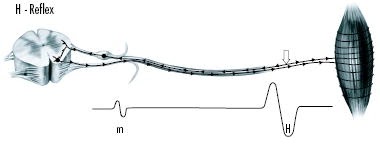
It was first suggested by Hoffman and it is useful measurement for rediculopathy and peripheral nerve pathy. It is the testing of both the integrity of sensory and motor monosynaptic pathway of S1 nerve root to some extent for C and C7. When a submaximal stimulus (below the threshold value) is applied to the peripheral nerve, the action potential travel along afferent neuron (I a) and synapse with the AHCs in the spinal cord. AHCs send information along the motor neuron causing contraction of the muscle.
The H – reflex latency is the function of age and leg length.
H – Reflex latency = 0.46 (leg length in cm) + 9.14 + 0.1 (age in years)
Note: Stimulatory electrode should be placed on muscle belly and recording electrode should be placed on muscle origin.

Electrodiagnosis


The diagnosis of the disease with the help of electrical modalities is called electrodiagnosis.

Types of electrodiagnosis:

  1. NCS
  2. Strength Duration Curve
  3. EMG